Back in September, I flew on United’s premium transcontinental service from SFO to Newark to Richmond. I also flew on one of American’s non-premium transcontinental services (from CLT to SFO). And just before this flight, I did a low cost transcontinental flight.
I was in New York seeing some friends for New Years, but shortly it was time to return to California. My travel plans for the return leg of my trip to the East Coast kept changing, and so I love how (nearly) all flights within the US now have no change fees. I changed this booking no less than 5 times between October and January. Finally, it all settled down to a Newark to San Francisco flight onboard United’s largest aircraft: a 777-300ER. I had just flown this same route in September in reverse. However, that flight was overnight, and I was continuing on to Richmond, but this time, the flight was in the evening, and I was awake to enjoy it.
I booked this flight in economy, since United’s premium transcontinental flights to/from SFO are usually very expensive. On my initial booking, I had put in a mileage upgrade award request on the waitlist, but I knew I had very little chance of actually clearing the upgrade. However, a friend of mine, who was Global Services with United at the time, had some extra Plus Points (which constitute United’s upgrade voucher system) that he applied to my booking. I instantly went from 47th in line to 4th in line for an upgrade. 72 hours before the flight, the seat map was showing 20 empty seats in United Business (domestic Polaris), so my odds were good. 48 hours before the flight, my upgrade cleared, as expected.
You may wonder why I was flying United despite a new calendar year (2023) having started. The reason is that British Airways’ tier qualifying year always resets on the 8th of a month, so any flights between January 1st and January 7th would not have counted toward my current qualifying year, and I had some United credits I needed to use. And it also turned out that Newark airport was actually way more convenient for me than JFK airport would have been. My experience with these transcontinental flights is that United treats these transcontinental flights as ‘Domestic First plus’ flights, unlike American, which I would argue generally treats them as ‘International minus’ flights.
I started my journey at United’s main terminal at Newark. Newark is a fortress hub for United, and it clearly shows. When you arrive at the United area at Newark, there are a number of different options for check-in. United has separate areas for Basic Economy, (regular) Economy, Premier (i.e. First Class and Elite members), Polaris (also accessible by 1K members), and a Global Services check-in area.
Since I was flying United Business and not Polaris, I only had access to the Premier check-in area (which I also had from holding United Premier Gold Status). Upon clearing security, I made my way to the United Club in Terminal C, which was directly beside the gate for my flight to San Francisco. That was extremely convenient.
As is the case on busy travel days, the United Club was very full. This was actually the third United Club I’ve now visited in Newark, and it’s definitely different from the hexagonal one and the one in Terminal A.
Entry into the United Club was handled by automatic gates, which was the first time I’d seen these in the US and anywhere since the Finnair lounge. The United Club is separated into various areas, including a dining area, a lounging area, a bar, and an area with large (shared) high-top tables. I struggled to find a seat/table that wasn’t already taken, so I opted to share a high-top table.
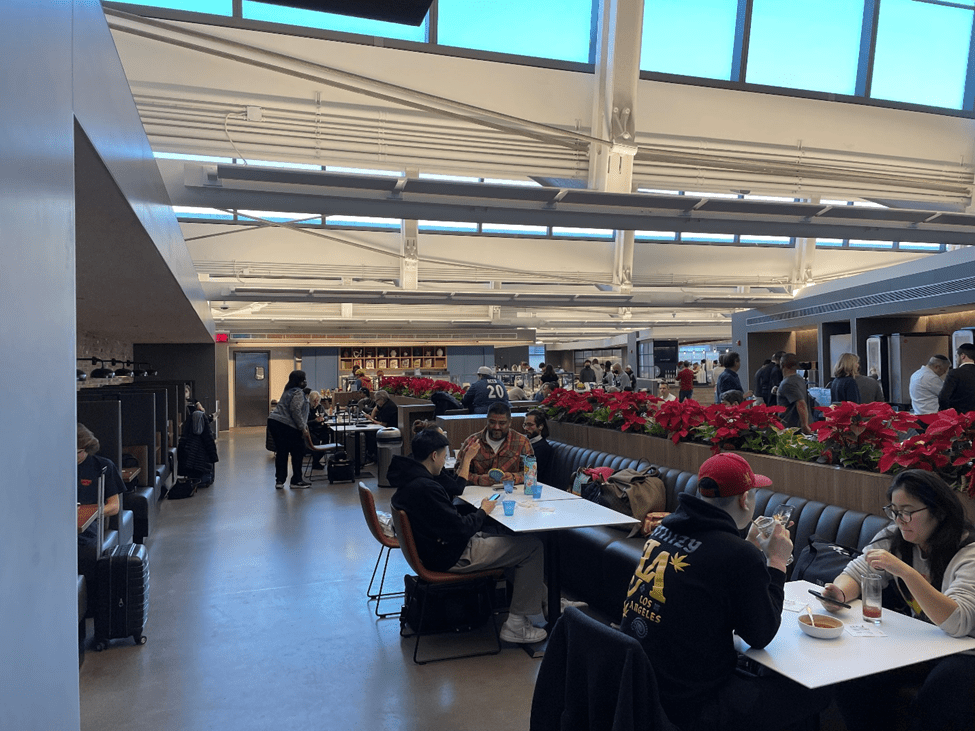
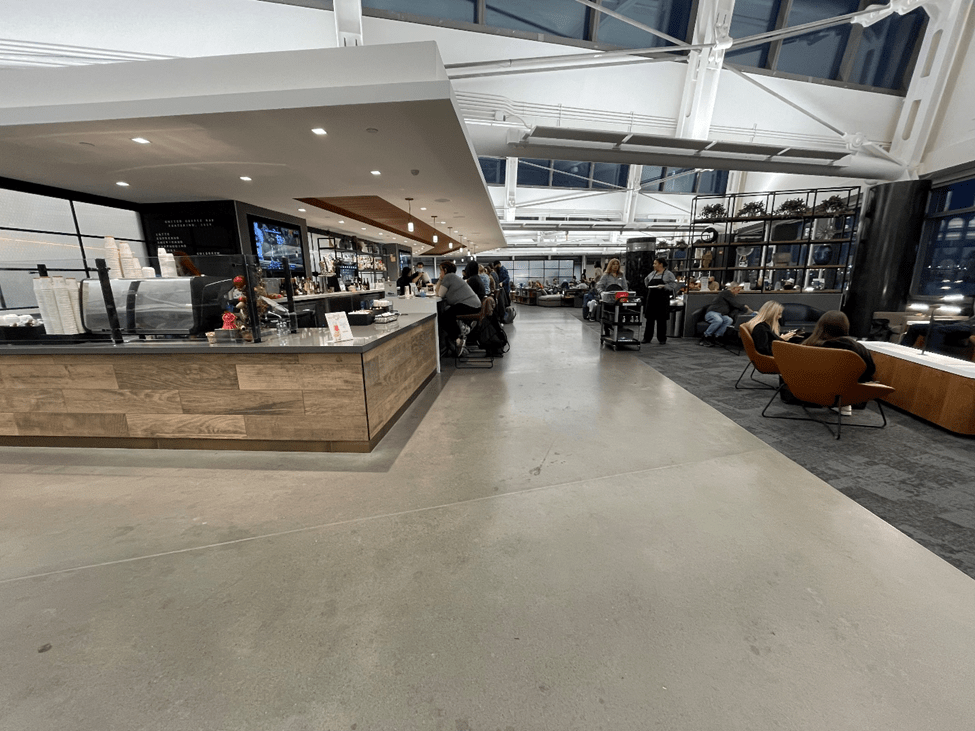
Given the line for the buffet, I decided not to hold it up by taking pictures.
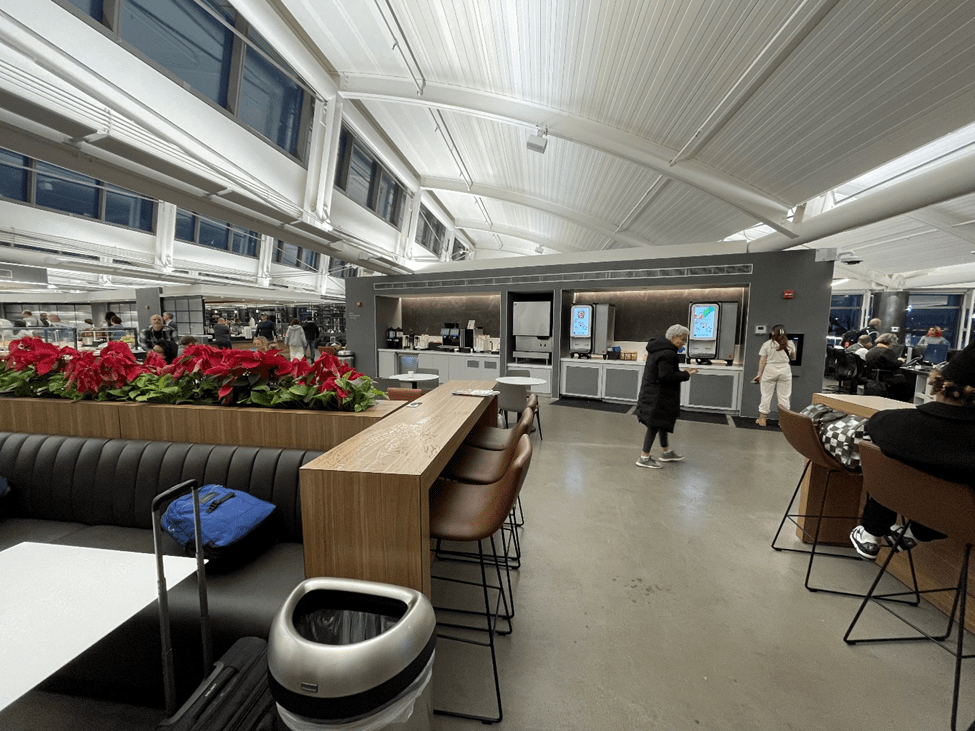
After about an hour in the lounge, it was time to depart. Boarding for the flight did not begin on time, which is typical for a flight from New York. All the flights from New York have substantial schedule padding due to the congested and complicated traffic patterns in and around New York’s airspace.
Since the lounge was not particularly interesting, I boarded with Group 1, which consists of top tier Premier members and Business passengers. I had selected seat 17L because it was the only ‘true window’ seat available.
The gate had two jet bridges, one for door one (marked as Polaris) and one for door two. For some reason, after Business had finished boarding, more people continued to use door one, which was disruptive for pre-departure service. They came around to take our orders, and, as per usual on United, they started with GS and 1K members and then did everyone else. As is common for both flights involving SFO and transcontinental flights, there were substantial numbers of top-tier elites on the flight. There were 48 people on the upgrade list when I last looked, which is a lot, but this route doesn’t qualify for complimentary upgrades, so that was 50 people who had applied Plus Points or miles to their booking to try to upgrade. Given that I was 47/48, that means most (if not all) of the people ahead of me on the list were GS/1K/Platinum.
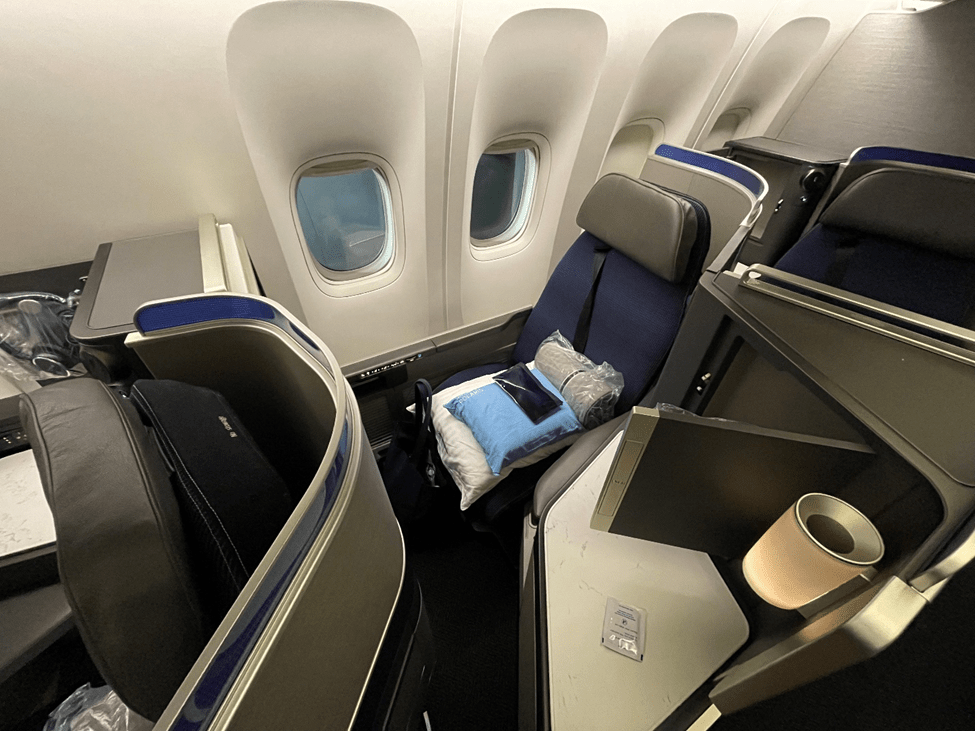
The United Polaris seat is my favorite business class seat offered by a US carrier, and these true window seats are the best seats in the cabin when traveling solo. I really like the finishes that United has on these seats, including the faux marble (which has aged very well), the blue trim, and the reading light.
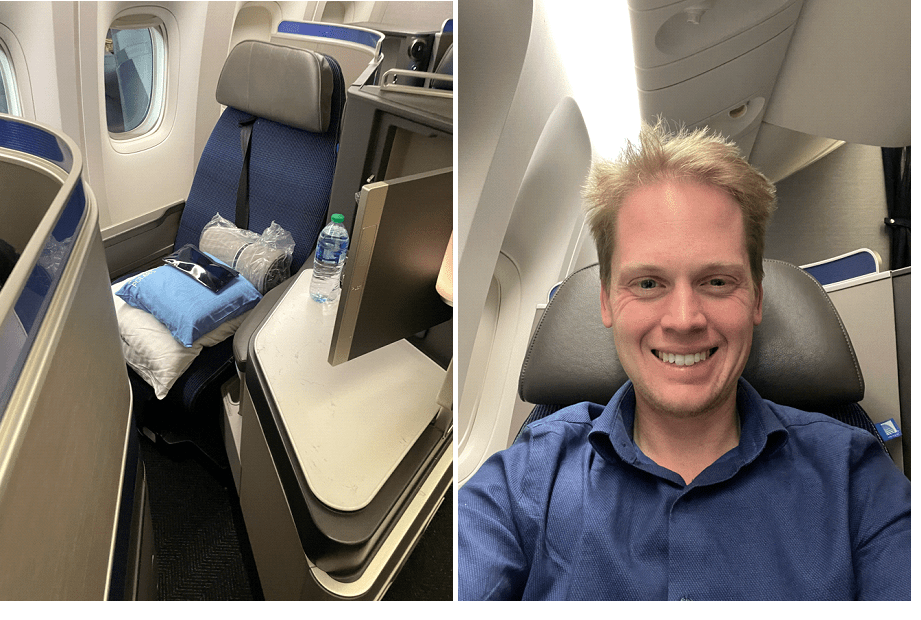
The 777 has the best Polaris seats, in my opinion, because they’re slightly wider than those on the 787 or 767. That being said, I think the 767 has the most fun layout with its unique 1-1-1 configuration. I’ve actually only ever flown Polaris internationally on 767s, and I’d never flown in Polaris (seating) on a United 777-300ER before. I have flown 777s domestically, both on premium transcontinental and on regular flights.
The flight was slightly delayed on departure, which is normal for flights from New York. Airlines put in a substantial buffer for flights that involve NYC airports to account for ground delays. For context, flights between the West Coast and Boston are routinely blocked off for the same amount of time, despite Boston being a bit farther.
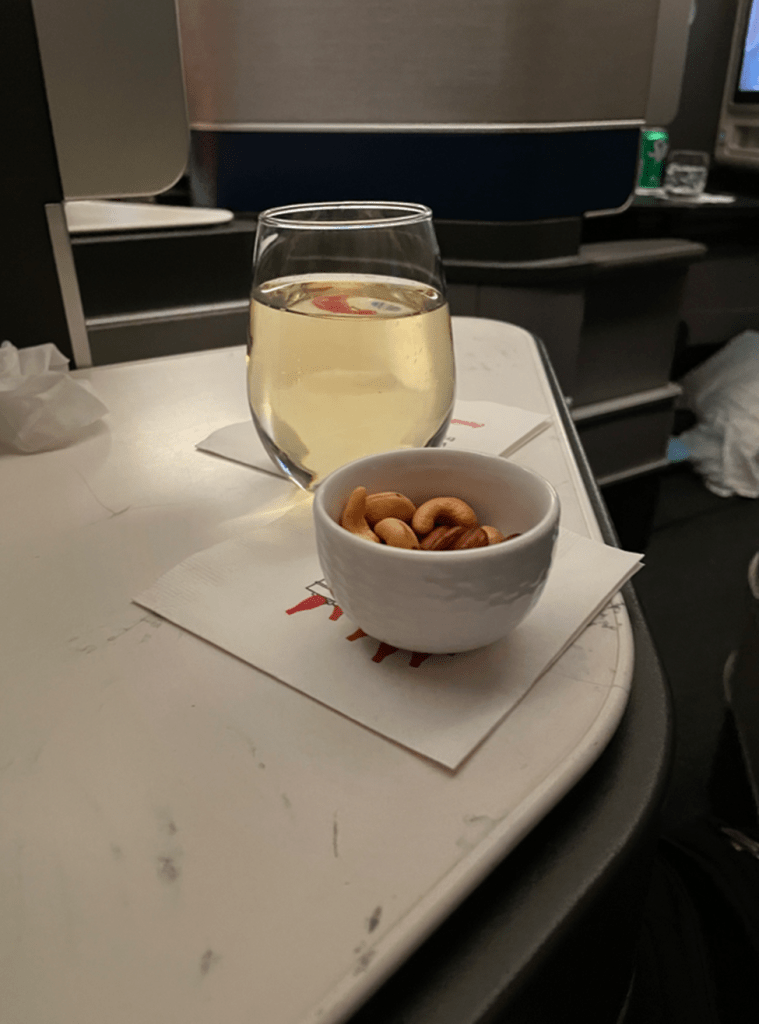
The meal service began with some bubbly and nuts as is usual in Business class. No menus were provided, which was a bummer, especially given that American provides menus on its non-premium transcontinental routes. And I even got a menu on a (long) BA intra-Europe flight.
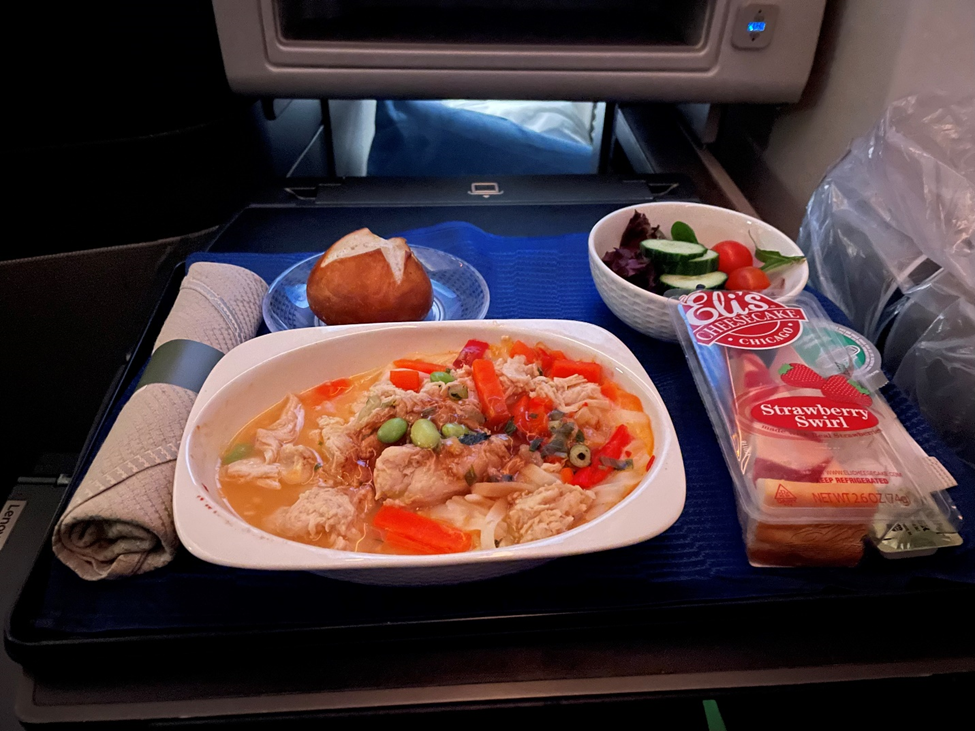
The meal service consisted of ‘three courses’ First was a basic, dry salad of about 10 pieces of lettuce, 3 cucumber slices and 2 cherry tomatoes. The main course was a Chinese-inspire chicken dish, which was very wet. The chicken and vegetables were cooked pretty well, but it was a pretty standard dish that tasted like airplane food. The pretzel bread was a hit as always. The strawberry swirl cheesecake was fine, but I’m not really a fan of cheesecake (and this was a relatively high calorie cheesecake anyway).
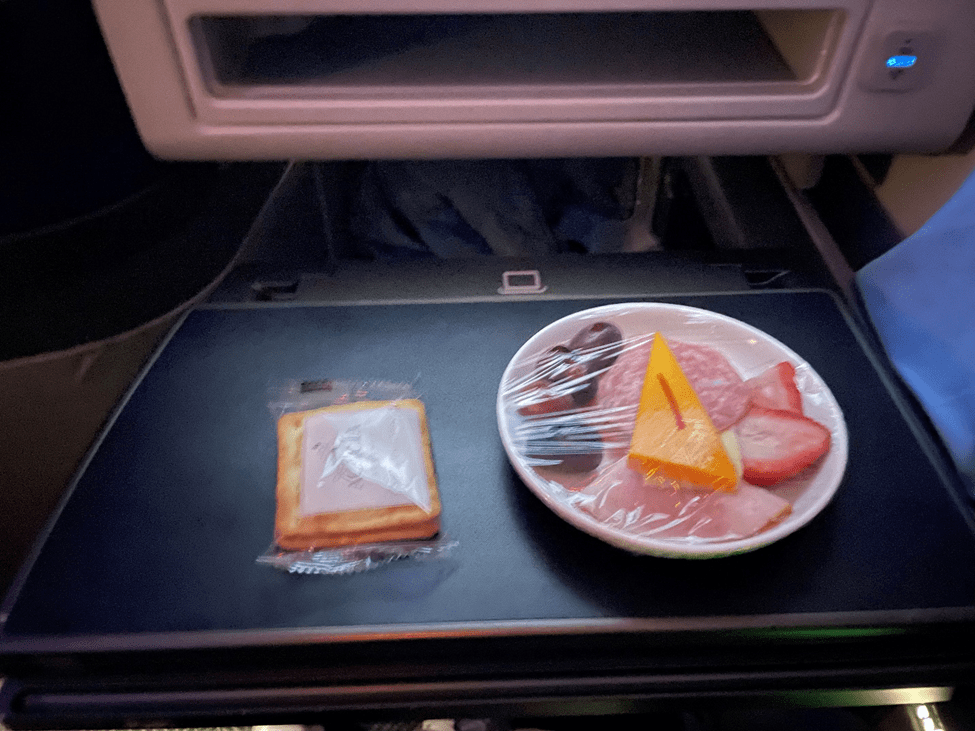
About an hour before landing, the flight attendant came around to provide a pre-arrival cheese plate to those of us who were awake. The cold cuts were pretty average and the fruit was a bit sparse, but given how short the flight was, a small pre-arrival snack made sense.
In summary, having a lie-flat seat for my flight was, of course, what I wanted and valued the most, and despite the soft product being lackluster, I thoroughly enjoyed this premium transcontinental journey with United. I’m glad I was able to upgrade to United Business for my last flight as United Gold. This flight was a major upgrade over my recent non-premium transcontinental journeys but was only possible at a reasonable price thanks to my friends. The ground experience in United was a marginal step up from a standard domestic flight in that I had access to the comfortable (but very busy) United Club (3/5). United’s Polaris seat is, in my opinion, the best business class seat offered by a US carrier and definitely the best available domestically (5/5). The meal on the flight was decent but wet, and the side dishes were basic US airline food (3/5). The service on the flight was similarly good, but as is always the case on flights to/from SFO, everyone holds high elite status, and so being a United Gold was almost the same as having no status (3/5). The IFE was excellent; I just wish Wi-Fi were included with a premium ticket (4/5). This premium transcontinental domestic flight was definitely a step up from non-premium transcontinental flights. It feels like to me that United’s differentiating factors are the aircraft type and offering club access and not the soft product (18/25), but it’s a huge improvement over flying in coach.
I paid around $370 for this ticket as a normal coach ticket on my Amex Platinum card (5x points/$), which earned me around 1 850 Amex points. I credited the trip to United, which earned me 2 808 award miles and 351 PQP. The total points earned are worth around $64, for a return of around 17%, which is decent, especially given that I was able to travel in Business using a friend’s plus points.
 Michael's travel blog
4 thoughts on “United premium transcontinental EWR-SFO”