After a great three days of hiking in Utah with my friends Alex and Ben, it was time to go see my family in Virginia. Like with many things these days, finding a convenient flight was not the easiest task. Since we were in southern Utah, St. George (SGU) was the closest airport, but it’s not a very large airport. The current St George airport is actually the second one. Until just under a decade ago, the old St. George airport was situated on top of a mesa and thus land-locked. Given St. George is a one of the most rapidly growing small metro areas in the US, a bigger airport was needed. They then built the current St. George airport with hopes that it would be more expandable. The pandemic, however, has cut a lot of that back for now at least. For example, American started flights to Dallas in the second half of 2019, which would’ve been very convenient for me for this trip, but those have been indefinitely suspended. As it stands now, SGU has one destination from each of the US legacy carriers (AA: Phoenix, UA: Denver, DL: Salt Lake City).
I spent two summers living and working in Salt Lake City, when I was an undergraduate, so I’m no stranger to Utah or its airports. I’ve flown out of Salt Lake City about a half dozen times, but this would be my first opportunity to fly out of St. George airport. The downside, though, is that SGU is much smaller.
For this trip, I had to take 3 flights. I could’ve done a two-flight option from Las Vegas, but it would’ve required us to have left St. George extremely early because of the poor connections onward to Richmond. And I was interested in checking out SGU. The connection I ended up settling on was St George -> Phoenix -> Dallas -> Richmond, for a total distance of 2 288 miles and a duration of just over 7 hours. The layovers were relatively unbalanced, with a 35 min layover in Phoenix and a 1 hour 47 min layover in Dallas. Given the short lengths of the first two flights 262 and 869 mi, respectively, no service was offered on either flights, so I think I’ll combine the two into a single post and then discuss the longest flight, the Dallas -> Richmond flight separately.
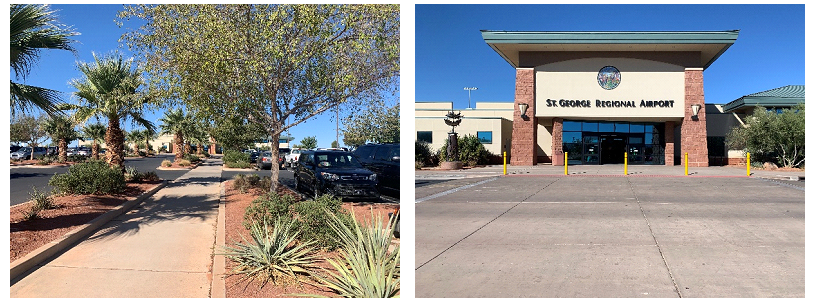
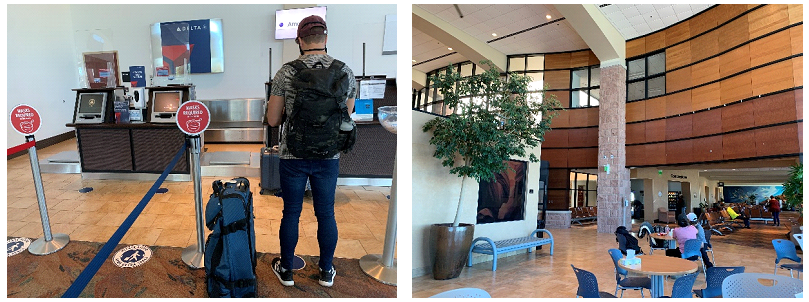
Ben and Alex dropped me off just over an hour before departure, which was earlier than planned because we’d had a remarkably efficient morning. The check-in area was small, with three desks for the three airlines, but two people working, who just moved between the desk as needed, haha. There was no priority lane available, so I just used to the self bag drop and then brought my bags up. The airport has no cafés, only vending machines. As one might expect, there is no lounge, nor would I have expected one. There is a viewing area, but given the lack of flights, I opted to just clear security. The security area was very small and took no time at all. Just past security was the gate area. I took a table by the window and just took in the desert scenery. In fact, that’s what I did for the entire short flight.
I watched the incoming flight on flightradar24 and then watched it taxi in. This first flight is on an American Eagle CRJ-700, which had 9 first class seats and just 56 economy seats. This usually translates into, especially on this short of a flight, everyone (who’s eligible) getting an upgrade. From my perspective, the cool part is that AA uses a (regional )aircraft large enough to have first class on such a short route.
Once everyone had deplaned and the plane was cleaned, boarding began, with American’s 9 group system. I was in group 1, since I was in first class, but like always, I opted to board last. Everything in the airport was on ground level, so I just had to walk to then walk up to the plane. I know a lot of people don’t like that, but it’s grown on me over the years to be able to walk up to my plane and climb in.
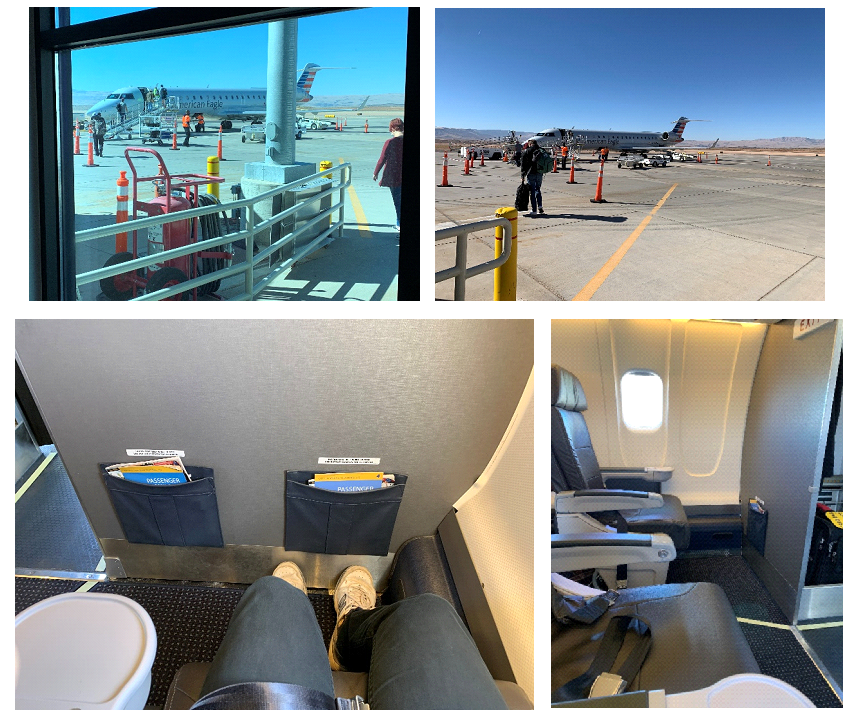
I took my seat, 1D, which was very comfortable and had plenty of space. There were only three of us in a first class built for 9, and we sat in seats 1D, 2A, and 3D, for maximum distancing. For social distancing (and cost saving) reasons, there was no service on the flight. Drinks could be requested from the flight attendants, but they didn’t walk down the aisle with a cart. Powerports and WiFi were available on the flight, as well as streaming entertainment. Given the short duration of the flight, I just opted to check out the beautiful views of Utah and then Arizona.

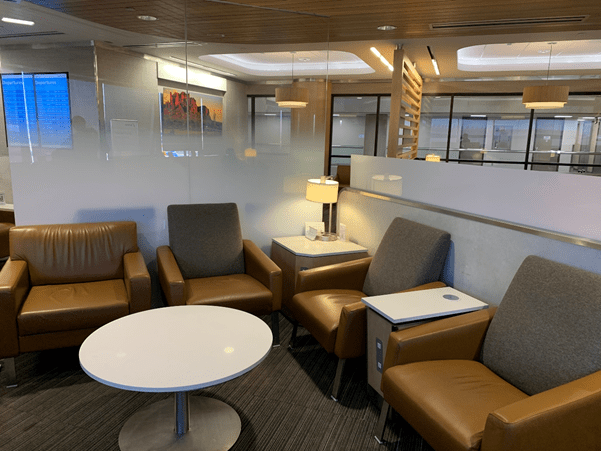
Upon arrival in Phoenix, I made my way from the A pier to the B pier for my next flight, AA1796. Phoenix really stood out as seemingly nearly as if there were no pandemic. It was a bit bizarre, but Phoenix has very few intercontinental flights (and only a handful of destinations in Mexico and Central America), so I guess the airport hasn’t seen as extreme a drop in traffic, compared to, for example New York’s JFK airport. I actually made it to the gate boarding had begun, and the gate for the flight to Dallas was directly beside an Admirals Club, so I opted to stop into the lounge briefly.
I had access to the Admirals Club through my Oneworld Sapphire status on BA (Silver), which is one advantage of using the BA program over the AA program. AA elites, like on United, don’t get lounge access on purely domestic itineraries. My pitstop in the lounge consisted primarily of some hummus, guacamole, and chips. The lounge was almost certainly an old US Airways Club, and the lounge was not very impressive. It was small, felt crowded for COVID-times (despite being capped at 50% capacity), and was noisy. Luckily, I found an emptier alcove. I was only there briefly before I went back down and joined the tail end of group 9.
I had reserved seat 1D for all three of these flights. I had noticed that there were 8 first class seats free (out of 20), but as is the case on most domestic US flights, at a few days out, the complimentary upgrades started clearing. Seats 1C and 1F (and 2 others) were empty going into the day of the flight, but the upgrade waitlist had about a dozen people on it, so I knew first class would be going out full, which is largely to be expected. Two men were chatting in 1D and 1F when I boarded (so they were almost certainly AA platinum members whose 500-mile upgrades had cleared), so I just asked the man in 1D if he was wanting to change seats with me, and he said, “I’d love that”, so I took my new seat: 1C. This second aircraft was an A321neo, which is a very nice, new plane. One pieces of interest, to me at least, is that the first class seats are identical to the American Airlines Premium Economy seats, which is fine with me; they’re quite comfortable, but not quite as squishy as the United 737 first class. The other point of note is that these A321neos have a large first class section (at 5 rows), compared to the older A321s, which have 4, but there is no bulkhead between first class and economy. Unless you’re in the last row of first class, it’s not a direct problem, but the lack of compartmentalization makes it almost feel like a regional aircraft (on which no divider between economy and first-class is standard).
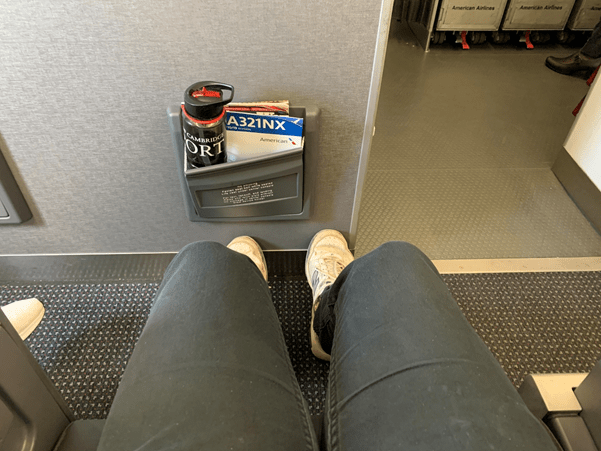
Like with the previous aircraft, there was no formal service on this flight, as it was 869 (< 900) miles. However, given the number of elites on this hub-to-hub flight (and its duration), the flight attendant volunteered that we could simply ring the call button, and she’d bring us drinks on demand. It seems to me that it’d probably have been more efficient both service-wise and COVID-wise to have just done a first class drinks service. Like on other AA aircraft, power ports, WiFi, and streaming entertainment were available. I used the power port for my laptop but opted not to use the WiFi given the short duration of the flights. If I’d thought about it, it might’ve been a good idea actually for me to have bought a month long WiFi pass; I think it would’ve been helpful and potentially cost-effective.
These flights constituted my 3rd and 4th domestic US flights during the pandemic. I’m not totally convinced on AA’s boarding system with its standard 9 groups, and the lack of service on the first flight was understandable, but on the second flight, it was a bit strange. The regional flight’s lack of lounge was expected, but the Phoenix Admirals Club was quite poor (1/5); it felt like a busy Manchester Airport contract lounge. Both seats were relatively standard first class seats and were comfortable. The first flight’s seat was better in my opinion, but that’s probably because of the empty aisle seat more than anything (5/5 and 4/5). The lack of any service on the first flight wasn’t a problem, but it was strange on the second flight and led to some inefficiencies (2/5). The flight attendants were friendly on both flights and were just following COVID rules, so I can’t fault them at all (5/5). The WiFi + streaming and powerport offer is standard for American and great for a regional aircraft (4/5), but I’d still prefer a personal screen on the A321neo (3/5). Overall, these two flights get a (15/20) and a (15/25). These two flights didn’t feel particularly first class to me, but at least I felt safe and comfortable on them.
From a points perspective, the first flight (AA2989 SGU -> PHX) netted me 40 BA tier points (which is the same for any Oneworld partner flight < 2000 miles). In addition, I earned 500 base Avios (the minimum) plus a tier bonus of 250 Avios (50% from BA Silver) and a ‘class bonus’ of 125 Avios (25%), for a total of 825 Avios. Even though there were no BA flights on this itinerary, I still earn the bonus points because of American Airlines and British Airways have a very strong partnership.
The second flight (AA1796 PHX -> DFW) netted me 40 BA tier points, 869 base, 435 tier bonus, and 217 class bonus Avios, for a total of 1 521 Avios.


6 thoughts on “St George Airport is so small, but it has first class! (An Autumn Escape part 6A/B, 2020)”